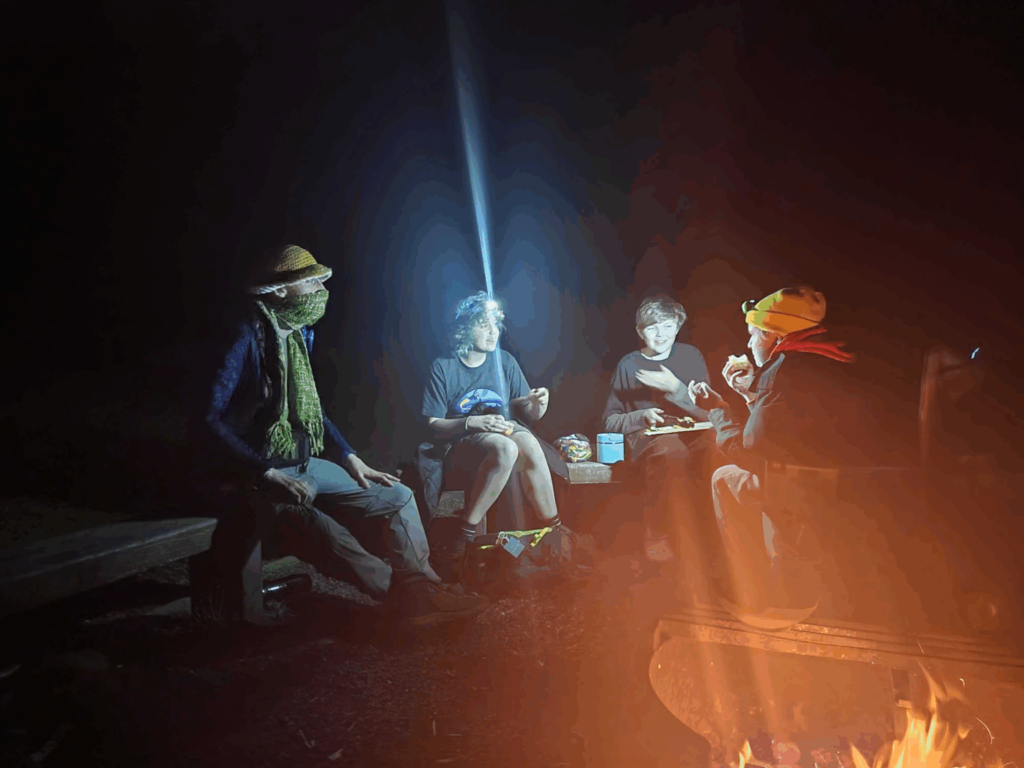
Students at PSII on a camping trip to Goldstream Park, one of the ways the Pacific School of Innovation and Inquiry balances tech with nature based experiential learning.
I was not able to attend the field trip to PSII the Pacific School of Innovation & Inquiry but was able to view two videos created during COVID that included an interview with a teacher from PSII and a tour of the school. I also asked a fellow student to share his impressions of the in-person tour so I will be reflecting on these three resources to report on my impressions of PSII in this post.
My colleague reported that students at PSII represented a higher than average number of designated students. The Tour included a sensory room which I have learned through my experience as an Educational Assistant is a must for any school and particularly helpful for students with autism or ADHD diagnoses. PSII has no outdoor spaces but follows a more flexible model than public schools as it lets students come and go when they wish. As the location is downtown, the proximity to the scenic inner harbor and Market Square helps to alleviate the lack of an outdoor chill space. Still, it would be amazing if in the future PSII was able to acquire a patio or some space for students and staff to socialize and enjoy a sunny day. Many of the rooms in the school, apart from one of the main working areas with large windows, were windowless.
Although this is an institution centered on tech, I think it is worthwhile to align technology with nature so that students don’t forget their relationship to the natural world. One project that was mentioned by a teacher at PSII was an outdoor sculpture that would incorporate wind and water into it. I hope there are more projects like that happening at PSII that encourage interacting with the natural world. Their work on projects is traced by teachers using the Platform Trello and they also meet with peers and supervisors in person or through zoom.
PSII is definitely an interesting learning model. It might be a good choice for students struggling with the traditional school system and seeking more freedom or creativity. Features such as a kitchen, craft and music spaces, dark room and 3D printer offer students options to pursue projects. The other student I chatted with mentioned the school is quite small with only around one hundred students so sports teams and other larger school possibilities like an orchestra or choir are not feasible at PSII, however there is still room for smaller endeavors like theatre and camping trips.
The interdisciplinary inquiry based approach to learning used at PSII also differentiates it from the traditional model. For students who are alienated from sitting in class for many hours a day being told what they have to do, PSII might offer a refreshing alternative. It seems to be much more student-led allowing students to engage in researching questions they come up with on their own and providing support along the way as new questions arise. This encourages students to take accountability for themselves which is a good opportunity at this young stage of life. Instead of complaining about lack of choices, students are challenged to create their own learning experience.